
How Wardogs Loot ESP Shows Crates and Dropped Items
A supply crate on the other side of a container and a bandage underneath a table are easy to miss for different reasons. One is hidden by the route you are taking, while the other blends into the ground. Wardogs loot ESP identifies those objects directly, using their names and distances rather than asking you to search every corner at eye level.
Our Wardogs cheats include Wardogs Internal, which separates dropped item ESP, ammo crate ESP and supply crate ESP. That separation is useful because you do not always need all three. You can focus on the object you are looking for while keeping player identification separate from the names of objects scattered across the area.
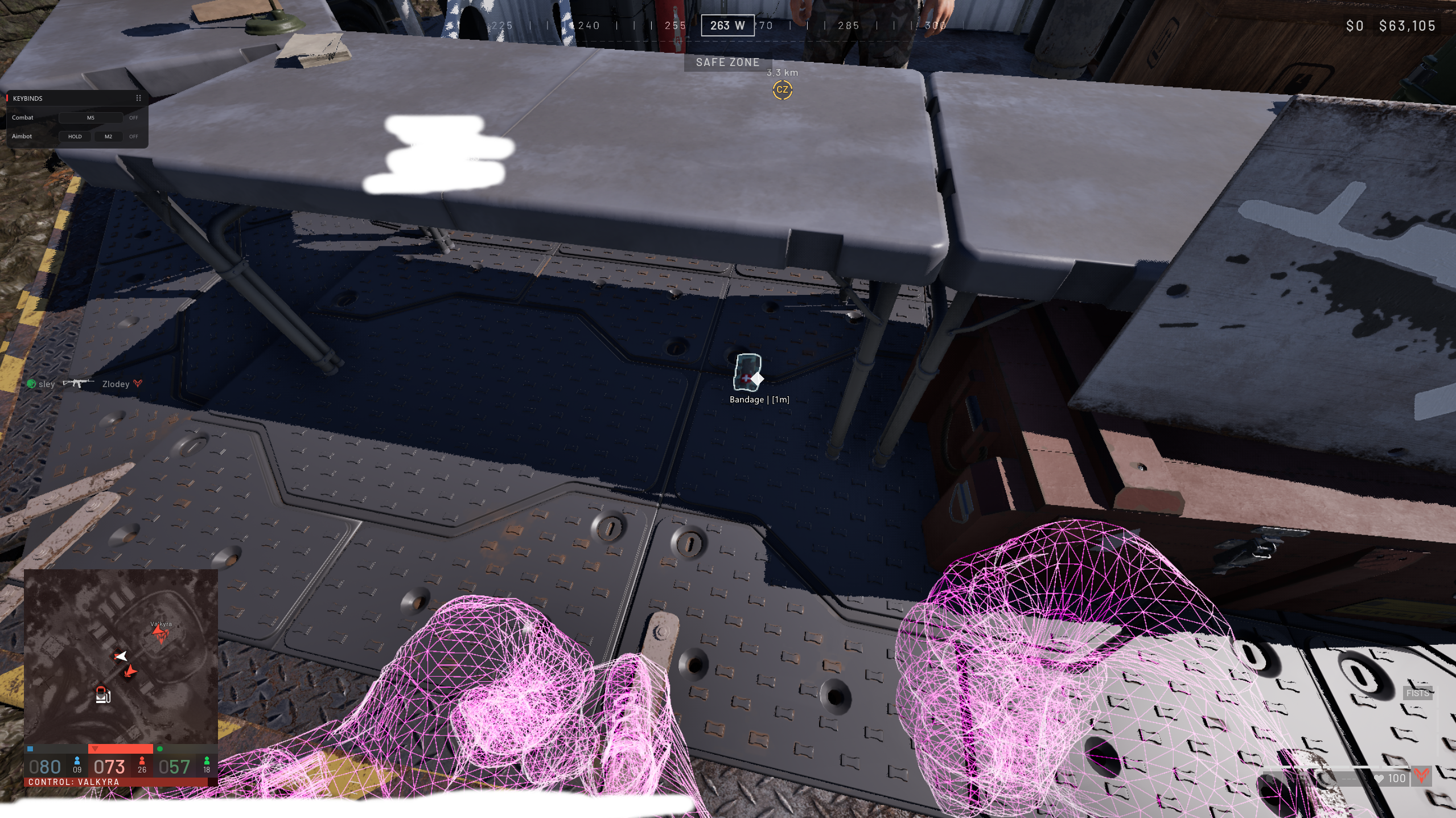
What dropped item ESP identifies
Dropped item ESP identifies objects lying in the game world. Item names tell you what the object is, while item distance tells you how far it is from your position. Shxdow's Wardogs Internal screenshots include a bandage beneath a table, which is a useful example of why a small object can be difficult to spot even when you are standing close to it.
A named object is more useful than an unexplained dot because you can decide whether you actually need it. Distance then helps you judge the travel involved. These two details have different jobs: the name identifies the object and the distance describes its position relative to you. Neither tells you that the route is clear, so keep the surrounding players and cover in mind before moving towards it.
Finding ammo crates and supply crates
Ammo crate ESP and supply crate ESP are separate features in Wardogs Internal. Each has its own name and distance display. Crate names distinguish the type of object, while crate distance helps separate several crates that appear in the same direction. This is particularly useful beside long containers or buildings, where similar objects can sit on different sides of the structure.
The product screenshots show supply crates at different distances around a container. The closest text on your screen does not necessarily represent the shortest walk, because a wall or fence can lie between you and the crate. Use the distance as a measurement to the object, then work out the route from the actual terrain. Wardogs loot ESP identifies the destination; it does not draw an accessible route.
Keeping loot ESP separate from player ESP
Player ESP answers questions about people. A held item identifies what a player is carrying, while a health bar describes that player's health. A dropped object has its own item name and distance. Keeping those meanings separate matters when a player stands beside a crate, because text belonging to the player can otherwise be mistaken for information about the object on the ground.
Wardogs ESP also includes skeleton ESP, faction ESP and off-screen arrows for players. None of those is a substitute for identifying the item itself. If you are trying to find a supply crate, additional skeletons do not make the crate name easier to read. Give each feature a specific purpose, and avoid filling the centre of the screen with several descriptions of the same busy area.
Reading names and distances around cover
Several nearby objects can overlap on screen even when they are separated in the world. Looking from a different angle can make the individual names easier to distinguish. A small change in position can also show which side of a table or container the object sits on. That is a practical way to interpret a crowded group of names without assuming they all refer to the object directly under your crosshair.
Distance changes as you move, so it gives you a second way to confirm that you are approaching the intended object. If the number is falling while the object remains behind cover, you are getting closer but may still need another route around it. Read the name and distance together. Looking only at the nearest number can send you towards a different item than the one you wanted.
How mine and claymore ESP differ from loot ESP
Claymore ESP and mine ESP identify explosives rather than supplies. Wardogs Internal gives each its own name and distance display, alongside the separate dropped-item and crate features. That distinction matters when several object types occupy the same doorway or approach. A supply crate name describes something you may want to reach, while an explosive name describes a hazard you need to recognise.
Do not treat distance text as a published blast radius or as proof that an explosive cannot affect you. The feature identifies the object and its distance; the game determines what happens around it. Ammo crates, supply crates, dropped items, mines and claymores are specific features, not interchangeable descriptions of generic loot.
Wardogs Loot ESP Questions
Does Wardogs loot ESP show dropped item names?
Correct. Wardogs Internal documents names and distances for dropped items. Its product screenshots include a dropped bandage identified beneath a table.
Are ammo crate ESP and supply crate ESP separate?
They are. Wardogs Internal documents each as a separate feature, with a name and distance display for both crate types.
Does loot ESP show what every crate contains?
The documented crate features are names and distances. A crate name identifies the crate type; it should not be read as an inventory of every object inside it.